
The request
A client sent scans of an older booklet-style passport of a citizen of Ukraine. The pages needed to be in English for a U.S. file. Passports look like easy documents, because most of the page is captions. In a booklet filled in by hand they are not, and this one combined two languages, cursive handwriting, a place of birth outside Ukraine and an issuing office described over four lines.
The document
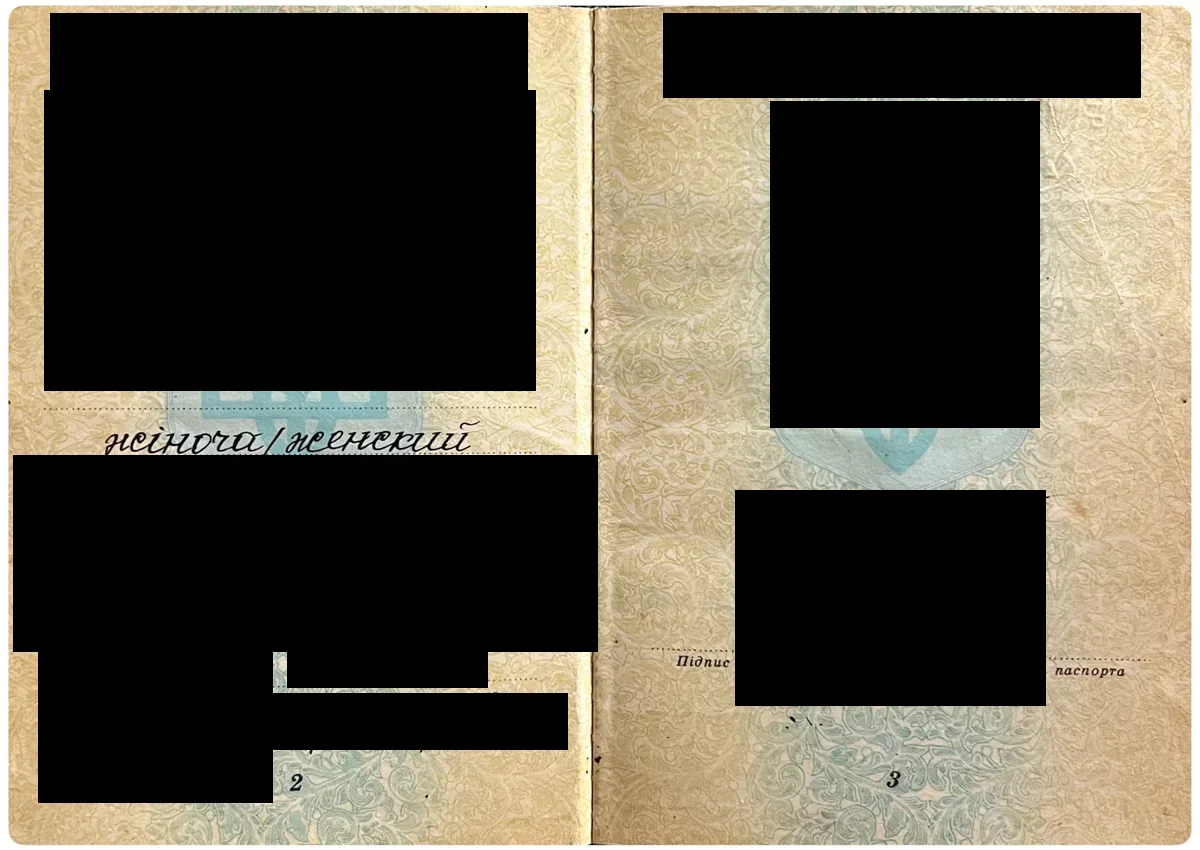
The identity pages hold everything. On the left: surname, given name, patronymic, date of birth, place of birth, sex, the authority that issued the passport, the signature of the official and the date of issue. The printed captions are in two languages, Ukrainian first and Russian second (“Прізвище / Фамилия”). On the right: the photo, set against the coat of arms, and the holder’s signature with its own bilingual caption. The series and number are punched through the pages as small holes along the top, so they read from both sides.
In this booklet the entries were written by hand in Russian. The date of birth gives the month in words. The place of birth names a city in another former Soviet republic, using the name the city had at the time. The issuing authority is a district office of internal affairs, written out with the district and the region across four lines, and a round seal sits over the lower part of the page, partly over the date of issue.
What made it tricky
- Bilingual captions, one-language entries. The translation renders each caption once in English and notes that the original captions are in Ukrainian and Russian.
- Cursive with a mixed alphabet. Russian and Ukrainian letters differ, and in cursive a few look alike. The issuing office line mixes both, which has to be read letter by letter.
- Old place names. A city that has since changed its name is translated as written. If the client wants the current name too, it goes into a translator’s note, not into the field.
- Perforated number. A number made of holes is easy to misread on a scan, especially where it crosses the pattern. It is copied and then checked separately.
- Seal over the date. The seal covers part of the date of issue. What can be read is translated; what cannot is marked as illegible.
How we handled it
The translation follows the booklet page by page and line by line: caption, then entry. Names are written in plain English letters the way the client’s U.S. documents spell them, or the current passport if there are none yet, so the translation of an old booklet does not introduce yet another spelling of the same surname. A translator’s note gives the booklet’s form. The date of birth goes in our U.S. format, and the note records the month as written in words. The photo is marked as [Photo of the passport holder], the signatures as [signature], and the seal is described with its legible text. The certificate states that the original contains Ukrainian and Russian. A second linguist checked the names, the dates and the number against the scan.
What the client received
One signed PDF by email: the English translation of every page sent and the translator’s certificate of accuracy and competence. For USCIS it is prepared to 8 CFR 103.2(b)(3), which applies to any document containing a foreign language that is submitted. For a consular case NVC asks for certified translations of documents not in English or the language of the country where you apply. In immigration court, 8 CFR 1003.33 asks for a translator’s certification that is signed and printed legibly or typed. The form instructions and the receiving office decide what identity evidence they need. We translate documents and do not advise on that.
If you have the same document
- Scan every page with an entry or a stamp, not only the photo page.
- Send the spelling of your name from your U.S. documents, or from your current passport if you have none yet.
- Send the receiving office’s published translation instructions, if any, so we can match the scope and format.
More on this document type: passport translation, Ukrainian translation, Russian translation.
How this page was prepared: the image is the client’s original identity pages with the number, every handwritten entry, the photo, signatures and the seal covered with solid black boxes. The translation itself is not shown.