
The request
A client needed a parent’s birth record from Guatemala in English. What they had was a two-page birth certificate printed by RENAP, the Registro Nacional de las Personas. Each country prints its acta differently, and this one carries several elements that a translation has to treat carefully: registry references written out in words, a photo, empty fields, and a set of codes meant for online verification.
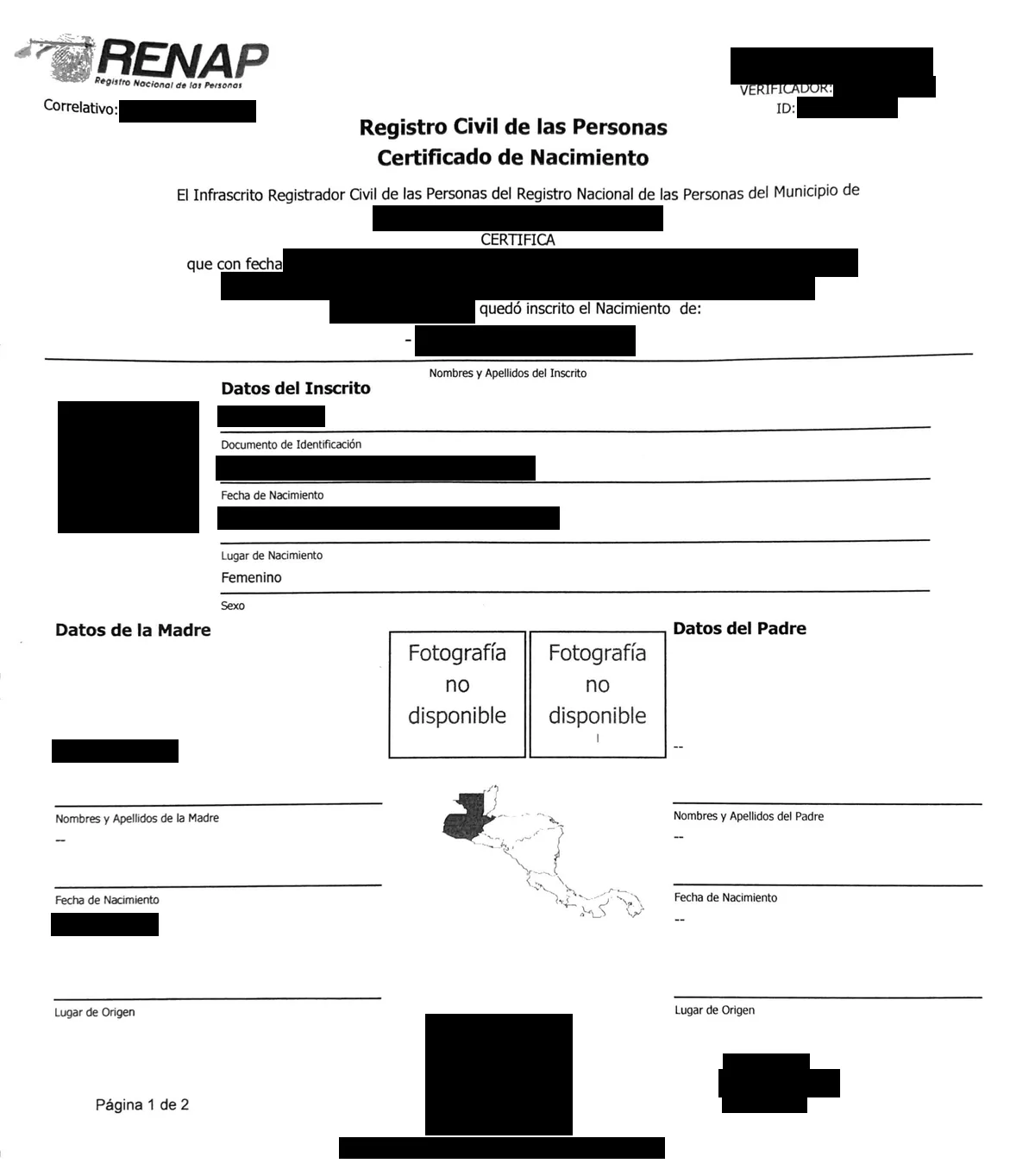
The document
The top of page 1 has the RENAP logo, a “Correlativo” number on the left and a barcode with a verification code and an ID on the right. Under the title “Registro Civil de las Personas, Certificado de Nacimiento” comes a certifying paragraph: the undersigned civil registrar of a municipality certifies that on a date, written out entirely in words, the birth of the named person was entered in a given entry (“partida”), folio and book of the civil registry of a municipality and department. The person’s full name follows on its own line.
The lower half is a data form. “Datos del Inscrito” holds the identity document number, the date of birth (again in words), the place of birth as department and municipality, and sex, with a photo on the left. “Datos de la Madre” and “Datos del Padre” each have name, date of birth and place of origin, with a photo box that reads “Fotografía no disponible” when there is none. A map of Central America marks Guatemala. At the bottom are a QR code, a long hexadecimal code, a timestamp block and “Página 1 de 2”. Page 2 carries the registrar’s notes section, an “ÚLTIMA LÍNEA” marker, the registrar’s signature and seal and a note on how to verify the certificate online.
What made it tricky
- Dates in words. Both the registration date and the date of birth are written out in words, day, month and year, not in figures. The translation gives each date in our U.S. format, and a translator’s note records the wording.
- Empty fields. The father’s section was printed with dashes. Leaving it out would make the translation incomplete; filling it in would be invention. It stays as dashes.
- Name format. The certificate writes the given names, a comma, then the surnames, between dashes. The translation keeps given names first, drops the comma and writes the name in plain English letters, spelled as the client’s U.S. documents spell it; a translator’s note gives the certificate’s form, accents included.
- Codes. Correlativo, verification code, ID and the long hexadecimal string have to be copied character for character, because someone may type them into a verification page.
- Non-text elements. Photo, barcode, QR code and map are described in brackets so the reader knows what sits where.
How we handled it
The translation follows the layout of both pages: header, certifying paragraph, the person’s data, the mother’s and father’s sections, the footer codes, then page 2 with the notes, the last-line marker, signature and seal. Field captions are translated next to their entries, so “Lugar de Origen” and “Fecha de Nacimiento” keep their place under each parent. Municipality and department names stay in Spanish, since they are proper names. A second linguist checked every code, number and date against the original before the certificate was signed.
What the client received
A signed PDF by email with the English translation of both pages and the translator’s certificate of completeness, accuracy and competence, the format that 8 CFR 103.2(b)(3) requires for USCIS. For a consular case, NVC asks for a certified translation of documents that are not in English or in the official language of the country where you apply. The translation renders the record in English. The office that receives it decides whether the record itself is sufficient evidence.
If you have the same document
- Send both pages; the second page has the signature and seal.
- Make sure the codes at the top and bottom are sharp in the scan.
- Tell us how your U.S. documents spell the names, or your passport if you have none yet.
More on this document type: birth certificate translation and Spanish translation.
How this page was prepared: the image is the client’s original first page. Names, identity number, dates, places, the photo, the barcode, all codes and the QR code are covered with solid black boxes. The translation itself is not shown.