
The request
A client preparing a USCIS filing needed an English translation of a birth certificate issued in the Soviet period in the RSFSR, now the Russian Federation. It is a small folded booklet: two facing pages, a printed form in Russian and almost every entry written by hand in ink. Certificates of this type are short, but they are rarely simple.
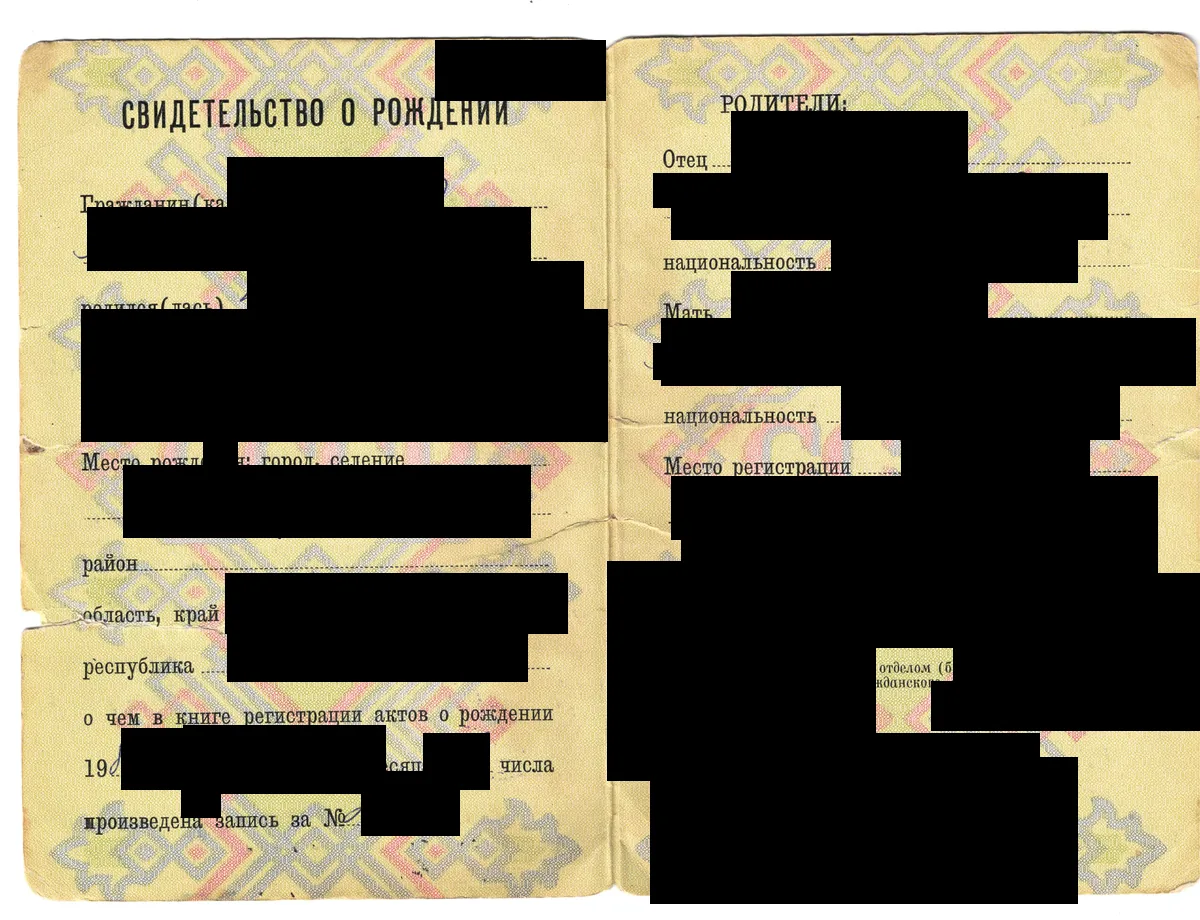
The document
The left page is the child’s record: surname, then given name and patronymic on a second line, the date of birth in figures followed by the year written out in words over two more lines, the place of birth split into city, district, region and republic, and the line “entered in the register of births on” with the year, month, day and record number. The right page lists the parents: surname, given name and patronymic, and nationality for each, followed by the place of registration (the name and location of the civil registry office), the date of issue, the head of the registry office’s signature and the series and number of the form.
Two items were added on top of the form. A round registry seal is stamped across the lower half of the right page, partly over the printed captions and the date of issue. Years later, an internal affairs office added a rectangular stamp recording that a passport had been issued to the holder, with its own handwritten date and number. A short handwritten note also sits above the title.
What made it tricky
- Handwriting over a patterned background. The security pattern runs under the ink, so some letters have to be read in context and checked twice.
- Patronymics. A Russian name commonly has three parts: given name, patronymic and surname. The patronymic is not a middle name, but in the English translation it sits between the given name and the surname, and it has to be spelled the same way on both pages.
- A year written twice. The date of birth is given in figures, and the year appears again in words. The translation gives the date in our U.S. format, a translator’s note records the year as written in words, and the reviewer checked that the two agree.
- Words that look dated. The parents’ nationality (in Soviet records, ethnicity rather than citizenship) and “RSFSR” belong to the Soviet form. A full translation renders them as written instead of modernizing them.
- Overlapping seal and a later stamp. The seal covers part of the text under it. The passport stamp is a separate event with its own date, so it is translated as its own item.
How we handled it
Our rule for names: plain English letters, given name first, spelled as the client’s U.S. documents spell them, or as the passport does if there are none yet, the same way on every line. A name with no existing Latin spelling gets a standard transliteration, and a translator’s note gives the form written on the certificate. The layout of the translation follows the booklet: left page, then right page, field by field, with each printed caption followed by its entry. The seal and the stamp are described in brackets, with the legible text inside them translated, and anything covered by the seal that could not be read is marked as illegible. The year written in words goes into a translator’s note, so the reader still sees what the registrar wrote.
Dates follow the U.S. order with the month as a word, so a reader at USCIS does not have to decide whether 04.12 means April or December. A second linguist checked every name, date and number against the original before the certificate was signed.
What the client received
One signed PDF by email: the English translation and a certificate stating that the translation is complete and accurate and that the translator is competent to translate from Russian into English. That is what 8 CFR 103.2(b)(3) asks for. Form instructions can add details; the Form I-130 instructions (edition 04/01/24), for example, ask for the translator’s signature, printed name, the date and contact information on the certification. The translation renders the record in English. USCIS separately decides whether the record itself is sufficient evidence.
If you have the same document
- Scan both inside pages, and the back cover if it has stamps, with all four corners visible.
- Type every name as your U.S. documents spell it (green card, USCIS notices, visa), or as your passport does if you have none yet.
- Tell us which office will receive the translation and send any translation instructions it publishes.
More on this document type: birth certificate translation and Russian translation.
How this page was prepared: the image is the client’s original certificate with every handwritten entry, the seal, the series and number and the later stamp covered with solid black boxes. The translation itself is not shown.