
The request
A client preparing a visa application for Spain sent us one PDF with two pages: an FBI Identity History Summary and, in front of it, the apostille the U.S. Department of State had attached. The translation was requested for a Spanish consular visa application. The client had already obtained the apostille, so it was attached when the PDF reached us.
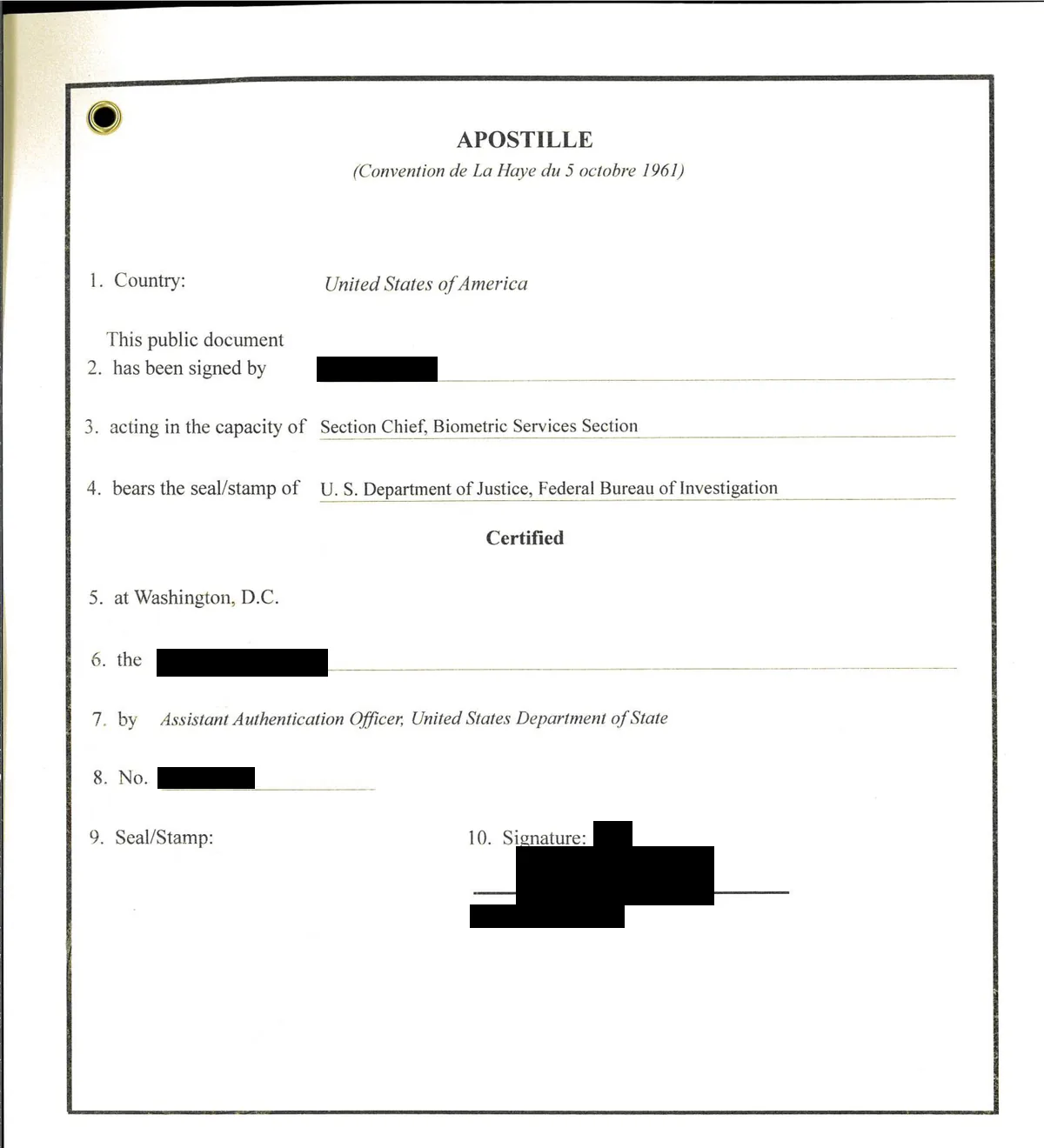
An apostille certifies the signature, the capacity of the signer and the seal on a public document (Articles 3 and 5 of the Apostille Convention). For a document issued by a federal agency, such as the FBI, the competent authority is the Department of State’s Office of Authentications, as the United States entry in the HCCH register states. Prime does not obtain, route or process apostilles. When the apostille is attached to the document you send, we translate it together with the document.
The documents
The apostille is a one-page form headed APOSTILLE with the subtitle in French, “Convention de La Haye du 5 octobre 1961”. Ten numbered fields follow: the country, the person who signed the public document, the capacity in which that person acted, the authority whose seal the document bears, the place and date of certification, the certifying officer, the apostille number, the seal and the signature. The sheet was fastened to the report with a grommet, and the scan shows it.
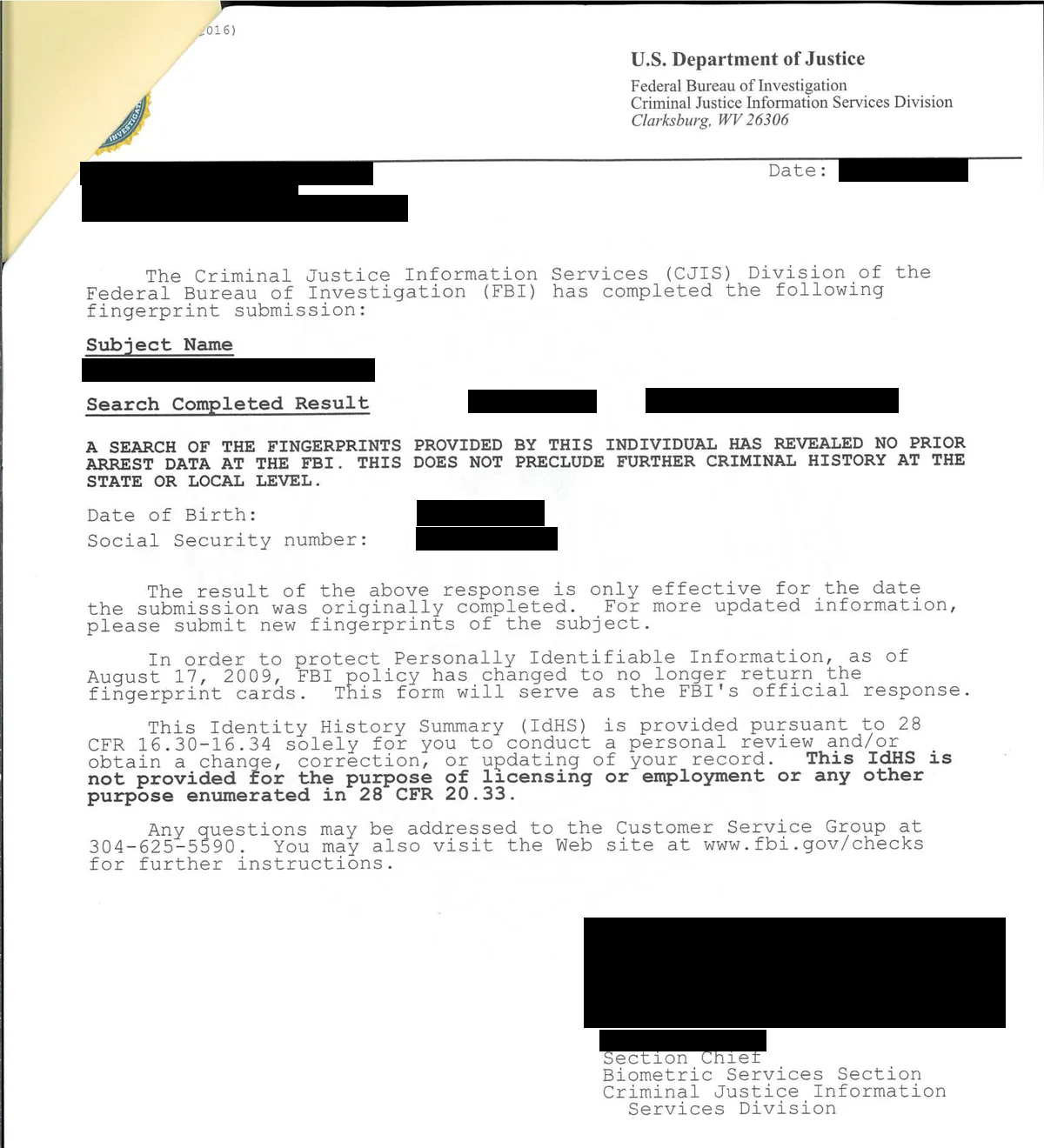
The FBI letter is typed in a monospaced font on Department of Justice letterhead. It gives the subject’s name and mailing address, the date, the result of the fingerprint search with a reference number, the date of birth and a partly masked Social Security number, then several paragraphs of standard text: what the result means, why fingerprint cards are no longer returned, the CFR sections under which the summary is provided, the purposes it may not be used for and a customer service contact. A signature block of the responsible section chief closes the page.
What made it tricky
- Two documents, one translation. The apostille refers to the signature on the report. If only the report is translated, the Spanish reader cannot check what the apostille certifies.
- Fixed field order. The ten apostille fields have to stay numbered and in order, with the French title kept and translated.
- Date formats. The FBI letter writes dates as month-day-year with hyphens. In the Spanish translation the day comes first, and the month is either a word (5 de marzo de 2024) or a number in DD/MM/YYYY form. A Spanish reader cannot swap day and month.
- The masked number. The original prints the Social Security number with most digits replaced by X. The translation reproduces it exactly as printed, without completing it.
- Legal boilerplate. The CFR references and the sentence on prohibited uses are part of the document. They were translated in full, with the citations unchanged.
How we handled it
We translated both pages in the order of the PDF: apostille first, report second. Names follow the client’s U.S. documents, here the report itself, in capitals where the original uses capitals. Seals and signatures were described in brackets in the place they occupy, so the layout of the Spanish text follows the original. A second linguist compared every name, date and number with the source before the translation was signed.
Spain gives official character to translations certified by a sworn translator (traductor/a jurado/a) whose title is granted by the Ministry of Foreign Affairs, European Union and Cooperation. For Spain we coordinate the work with accredited sworn translators appointed by that Ministry. The translation is delivered as a PDF signed with the sworn translator’s qualified electronic signature, as Spanish rules allow under Orden AUC/213/2025. For other countries the same document goes out as our standard certified translation.
What the client received and where it went
The client received one PDF by email: the Spanish translation of the apostille and the report, signed with the sworn translator’s qualified electronic signature, as Spanish rules allow. The translation was prepared for the client’s consular visa application. Whether the file is complete, and how long the FBI result stays valid for a visa, are decisions of the consulate. Each Spanish consulate in the United States publishes its own checklist; the Los Angeles consulate, for example, lists the FBI record with a Hague apostille from the Department of State in Washington, and the Houston checklist for a non-working residence visa includes a criminal record check certificate.
If you have the same document
- Prime does not provide apostille services; the client obtains the apostille. For an FBI record the competent authority is the Department of State, for a state record the state’s authority. If it is attached, we translate it with the document.
- Send us the complete PDF with every page, including the apostille.
- Tell us the country and the office, and whether it asked for a sworn translation.
How this page was prepared: the images are the client’s original pages. Names, addresses, dates, reference numbers, signatures and the apostille number are covered with solid black boxes. The translation itself is not shown.