
The request
A client with a medical college qualification from Ukraine needed the documents in English for an evaluation of foreign education. The set was the usual one: a hard-cover diploma and a supplement listing every course with hours and grades. Credential evaluators review course titles, hours and grades closely, so the brief was simple to state and strict to follow: translate word for word, keep the structure, convert nothing.
The documents
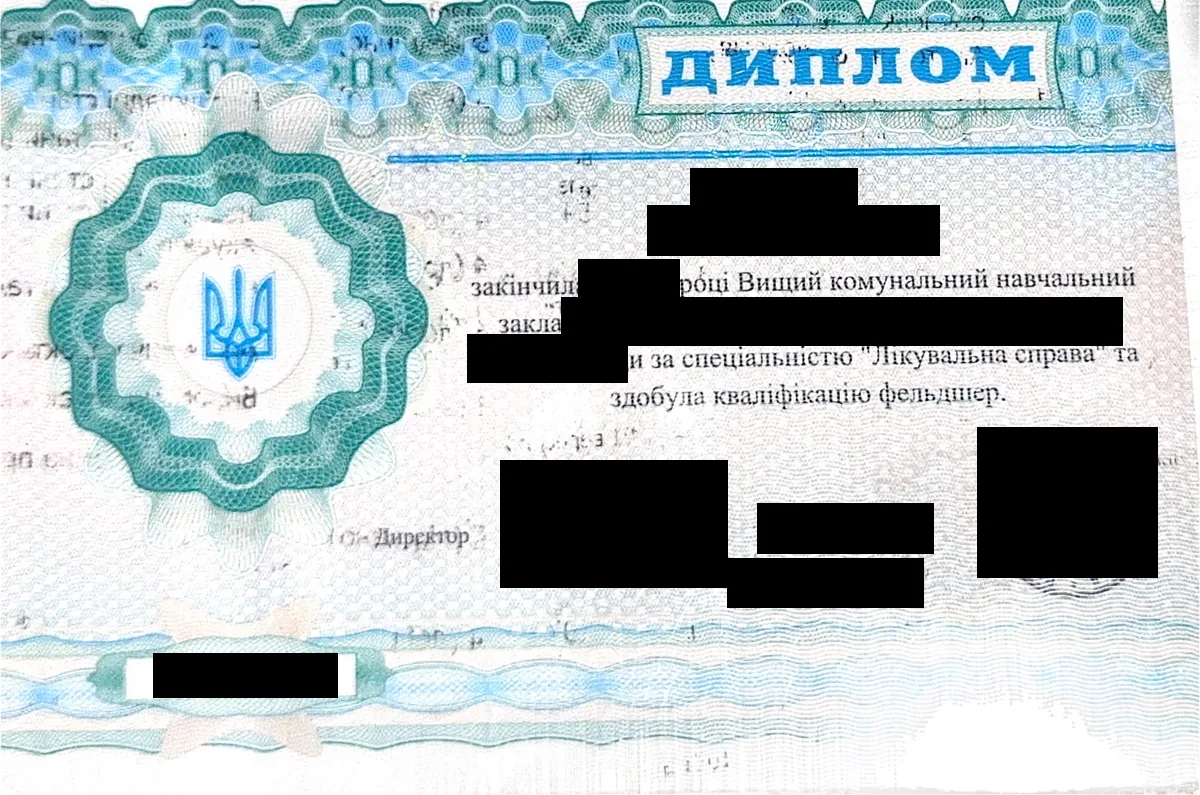
The diploma is a junior specialist diploma (диплом молодшого спеціаліста). Under the national coat of arms and the word ДИПЛОМ, one sentence carries the content: the graduate completed a named higher educational institution in a given year in a named specialty and obtained a named qualification. In this case the specialty was general medicine and the qualification was feldsher (фельдшер). The director’s signature and name, the institution’s seal, the date of issue and a series and number complete the page.
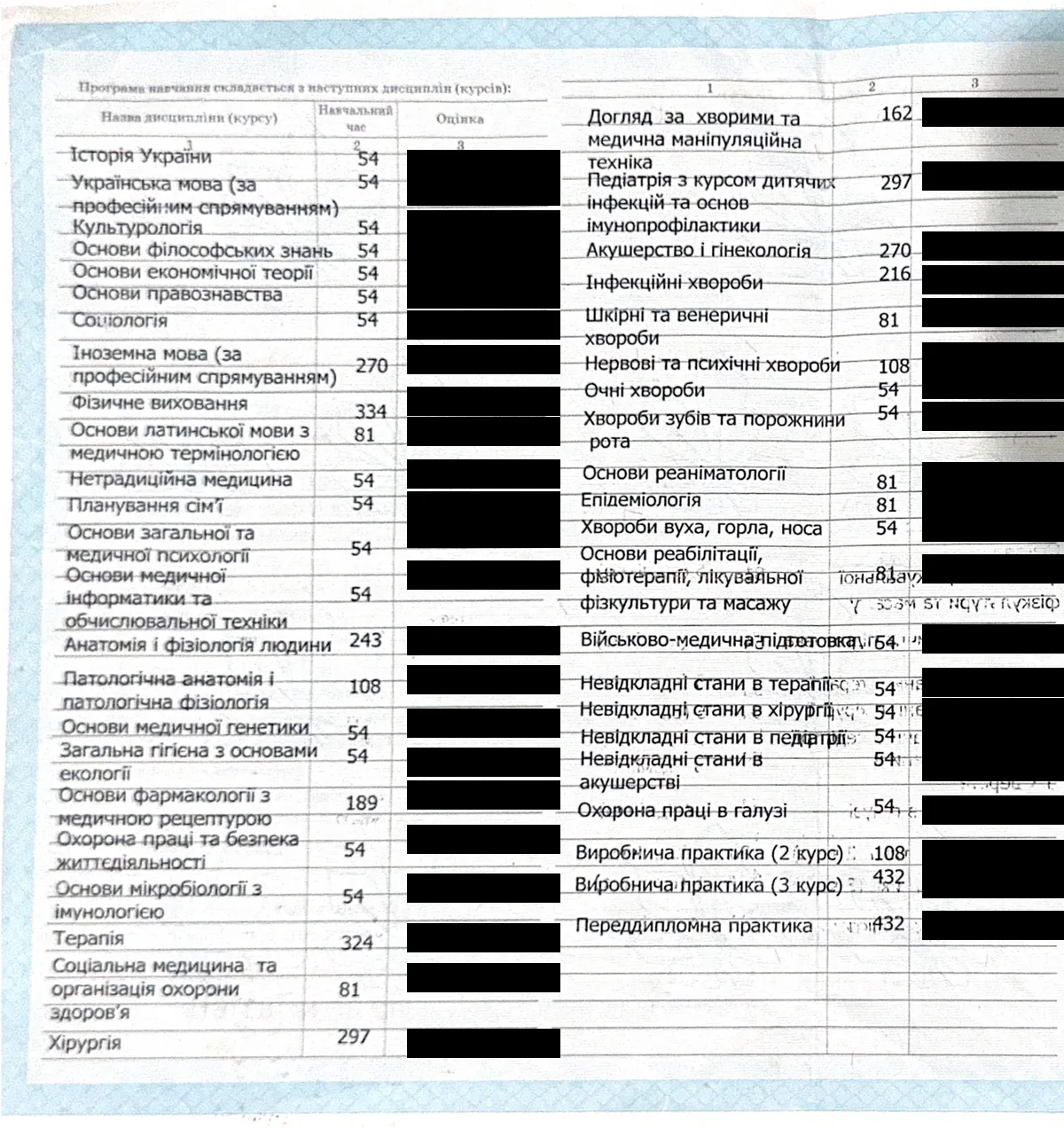
The supplement is a table on several pages. Each row gives the course name, the teaching hours and the grade, written as a digit and a word: 5 (excellent), 4 (good), 3 (satisfactory). Physical education is marked “passed” instead of a number. The last rows list the practical training periods by year of study and the pre-diploma internship, each with hours and a grade. The paper is thin, and the reverse side shows through as mirrored text.
What made it tricky
- A degree title we do not convert. “Junior specialist” and “feldsher” are translated literally. Writing “associate degree” or “physician assistant” would be an evaluation, and equivalency is the evaluator’s job; WES, for example, publishes its own equivalency for this qualification.
- Grades with words. The digit and the word are both on the document, so both go into the translation. Nothing is converted to letter grades or a GPA.
- “Passed” is not a number. A course marked as credited without a grade keeps that wording.
- Long course names over two lines. Names such as the foreign language course “for professional purposes” wrap on the original. In the translation each stays one row with its own hours and grade.
- Show-through. Mirrored text from the reverse can look like an entry. We translate only what is printed on the page itself.
How we handled it
The diploma sentence was translated as one sentence, with the institution’s full official name, the specialty and the qualification in the order the original gives them. The graduate’s name is written in plain English letters, given name first, as the client’s U.S. documents or passport spell it, with the diploma’s form in a translator’s note. The supplement was rebuilt as a table with the same three columns and the same row order, so an evaluator can put the original and the translation side by side and find any course quickly. Hours were copied as numbers; grades were given as digit plus English word. The series and number, the seal and the signature were rendered or described in place. A second linguist compared every row of the table with the original before the certificate was signed.
What the client received and where it went
One signed PDF by email with both documents translated and a certificate of accuracy. Evaluators set their own rules. WES asks for exact, word-for-word translations by a professional translator, does not accept translations made by applicants, and takes uploads as PDF or JPEG. ECE requires translations of non-English documents but lets applicants translate their own documents word for word and offers a paid translation waiver for some report types. Other evaluators have their own lists. For documents submitted to USCIS, the translation rule is 8 CFR 103.2(b)(3). The evaluation itself, and any U.S. equivalency, come from the evaluator, not from us.
If you have the same documents
- Check your evaluator’s document list before ordering, and send everything on it.
- Scan every page of the supplement, including pages with only signatures.
- Tell us the evaluator’s name; we will tell you whether we can meet its translation rules.
More on these document types: diploma translation, academic transcript translation and credential evaluation.
How this page was prepared: the images are the client’s original diploma and a supplement page. The graduate’s name, the year, the college, signatures, seals, numbers and all grades are covered with solid black boxes. The translation itself is not shown.